
In Conversation
When a daycare center joins globegarden: Marco Spitz and Galla Stambuk in conversation
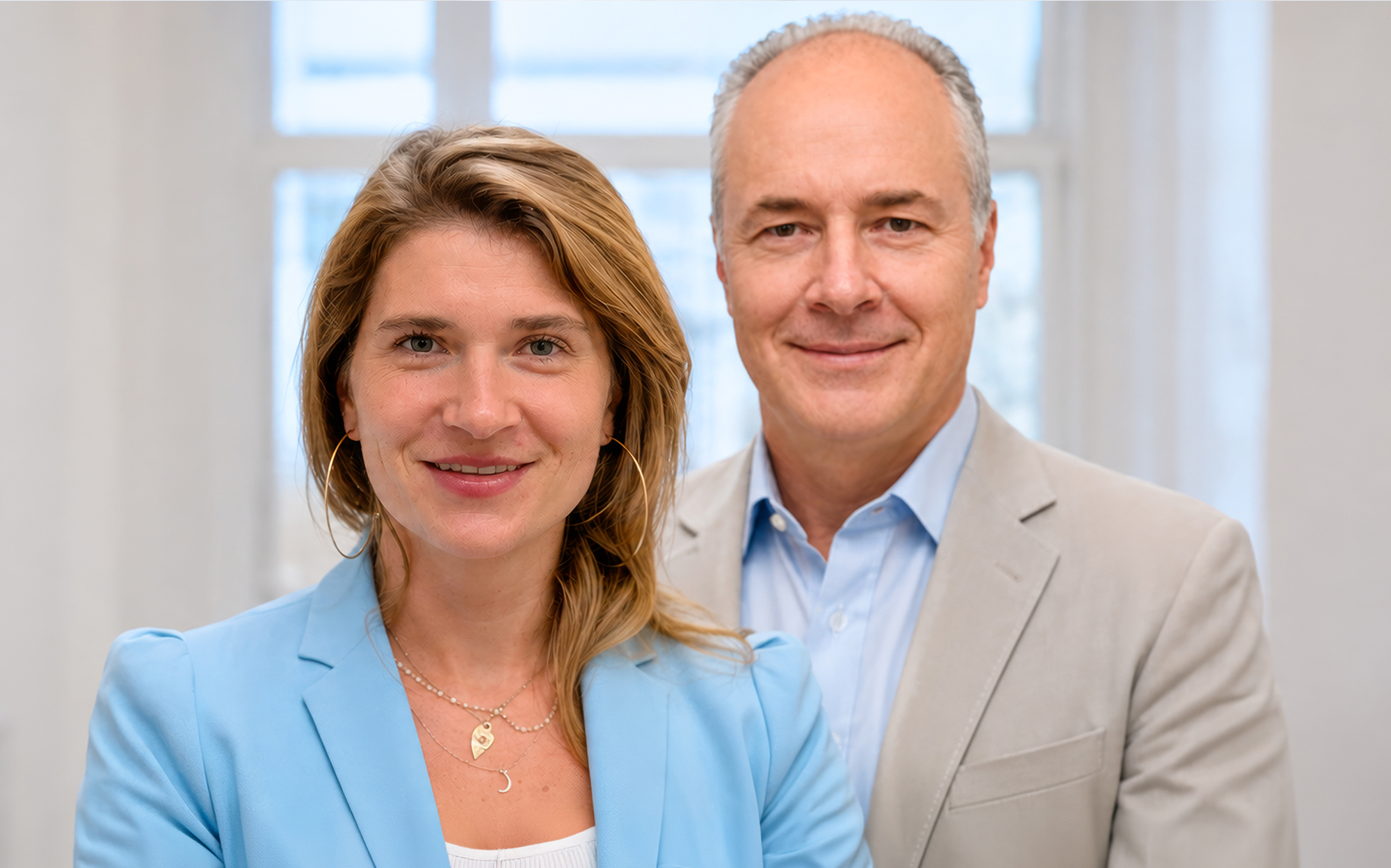
Marco Spitz is responsible for operations and succession solutions at globegarden, Galla Stambuk for the Family Service. Both are members of the management board. A conversation about what happens when a daycare center joins the network, and what changes for families and teams and what stays the same. The conversation took place in November 2026.
How did you come to globegarden?
Marco: By a detour. In the late 1990s, I was a management consultant, and one of my clients was the Swissair Group. They wanted to run a daycare center at Zurich Airport. That was my first contact with childcare, and the topic never let go of me. A few years later, in 2006, I co-founded my own childcare network with a partner and built it up to more than 30 centers over twelve years. Back then, most daycare centers were still run by associations. That a network like globegarden could grow out of private initiative in Switzerland, where childcare was long seen as a private family matter, still strikes me as remarkable. I knew the founders from those years, and we always held each other in high regard. After I sold my shares, they asked me in 2020 whether I would like to join. I didn't have to think about it for long.
Galla: For me, it was a career break. Before my children, I had a management position with long days and weekend work. After my son was born, I took a break. After about a year, I wanted to go back, at least 60 percent, and I honestly asked myself whether it was worth it given the cost of childcare. My best friend, my children's godmother, worked at globegarden and said: "Why don't you apply?" I started in 2017 and wanted to take it slowly. After a year, the founders offered me the lead of the Family Service. I actually had other plans, but I couldn't say no.
Marco: I know that feeling. It's hard to say no to those three.
Why do daycare centers look for a successor?
Marco: The requirements for daycare centers keep rising. Today, a single center has to handle a great deal on its own: finding qualified staff, training, safety and hygiene concepts, administration, IT. In a network, we carry that together. For many, it isn't easy financially either: around a third of daycare centers in Switzerland are running at a loss, as a survey by the industry association has shown. Some centers come to us because they can no longer manage on their own. More than 20 centers have joined us this way, at the request of their previous owners. I know from my own experience how much heart goes into a center like that. That's why I understand well what someone goes through at that moment.
Galla: That is exactly when parents understandably have many questions and expectations. Sometimes they don't know how close it was for their center. They don't need to. What matters to us is that the children keep their familiar center and that the team is still there for them.
What happens when a daycare center joins globegarden?
Marco: It always starts with a confidential conversation. We get to know each other and look together at whether we're a good fit. Not every request suits us, and it's important for both sides that it feels right. If it does, we review everything carefully and make a plan for when and how we inform the team, the parents and the authorities. We set the timeline together with the founder. And at the end, we celebrate the farewell together. After so many years of building something, that belongs to it.
Galla: From that moment on, my team comes in. We inform parents early and personally, and from day one our Family Service answers all their questions.
What changes for families?
Galla: First, the most important thing: our goal is that what is familiar stays the same for families, meaning their place, their caregivers and their daily routine. What's new is that from day one they have the whole network behind them. One example we see often: many families move when their second child arrives. The first child still fit into the city apartment, but for the second you want an extra room. Because we have centers in many places, children can often switch within the network. That takes a lot off parents' shoulders at an already demanding time.
Marco: And over time, parents also notice that we invest where it matters most for the children: in the rooms, the play materials and the team.
What stays the same in the center, and what's new?
Galla: A lot can stay as it is. Whether a center is German-speaking or bilingual, has a nature-based concept or a special offer for the youngest children: families are attached to "their" center, and we respect that. What applies everywhere is safety, child protection and our quality standards.
Marco: We go step by step, usually over about two years. First come the foundations such as safety and quality standards, then the culture: our values, team days and training.
What is the SWAT team?
Galla: The name always gets people talking. When a center joins us, the team has many questions, and that's completely normal: What will change, how does the new organization work, what does it mean for me? At the same time, the children are there and need their caregivers. So that these conversations don't all have to take place late in the evening, we have our SWAT team. They are experienced colleagues from our centers. They help out in the groups during the first period, so that the team can clear their heads and we can discuss all questions calmly. In German, SWAT stands for Stärkenorientierung, Wertschätzung, Achtsamkeit and Teilhabe: a focus on strengths, appreciation, mindfulness and participation.
Marco: So it only shares the name with the police special unit. But when four experienced caregivers show up at the door on the first morning with boxes full of play materials, it does feel a bit like a mission.
Marco Spitz, you once said: "Not all of us wear fluffy slippers here." What did you mean?
Marco: That childcare is a profession, and a demanding one. Some people think of cuddling and crafts when they think of a daycare center. That's part of it, but behind it are clear processes: who is there when, what happens in an emergency, how you keep every child in view. Clear processes don't make a center colder. They make sure that the warmth reliably reaches every center, even on a hectic Monday morning.
Galla: Everyone still wears slippers here. At least the children.
How do the two of you work together?
Galla: Very closely, especially when a center joins us. Marco thinks in processes, I think in families.
Marco: And Galla is usually right. When I say the plan is ready, she asks: "Nice. And who explains it at seven tomorrow morning to the father standing at the door with lunch boxes, a laptop and two tired children?"
Galla: In return, Marco has a calm I sometimes envy. With him, even the biggest renovation looks like a walk in the park.
What would you like to tell parents whose center is joining globegarden?
Galla: Ask us anything, even the small things. News like that takes some getting used to for parents, and we understand that well. My own children went to a globegarden center. I know how important it is to trust the team. That's why it matters so much to us that the familiar team stays there for the children.
Marco: And give us a little time. After a year, we often hear: "Actually, not much has changed, but some things have become easier." For us, that's the nicest compliment.
Read more in our FAQ: What changes when a center joins globegarden? Galla Stambuk tells how she combines family and career in our book «brave not perfect». How it all began: The founders in conversation.